Container Grandstand Materials: How to Avoid Corrosion, Structural Failure, and Compliance Rejection Most buyers only realize the problem too late Three issues quietly destroy the investment in container viewing platforms – and these hidden dangers are completely not shown in the basic quotation: Because the steel was not designed according to the climatic conditions of […]
Most buyers only realize the problem too late
Three issues quietly destroy the investment in container viewing platforms – and these hidden dangers are completely not shown in the basic quotation:
Because the steel was not designed according to the climatic conditions of the actual installation environment, the frame will be corroded and damaged within 2 to 3 years.
The structure deforms when carrying a full load of people because the frame was built according to general specifications rather than the actual load-bearing capacity of the site.
The project gets stuck at customs or fails the tender review due to materials not meeting the certification requirements of the destination market.
When these situations occur, the viewing platform has already been installed – and the cost of repairing it is much higher than selecting the correct type before construction. Here are the methods to prevent each problem.
Reason: Salty and humid air and high humidity significantly accelerate the oxidation rate of steel, far exceeding that in inland environments. According to the corrosion engineering data from NACE/AMPP, marine and coastal atmospheric environments are the most severe corrosive conditions for unprotected carbon steel – untreated frames can exhibit measurable deterioration after continuous exposure for several years.
Solution: Before the manufacturing process begins, rather than after installation, it is necessary to specify the use of anti-corrosion steel frames with rust-proof coatings. Usually, a combination of hot-dip galvanizing and protective topcoats is adopted instead of simply painting the steel, as the latter can only delay corrosion but cannot prevent it. Then, regular anti-corrosion maintenance should be carried out for the container platforms.
How to verify: Test to confirm whether the paint layer meets international standards.
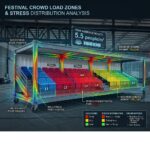
The price of the stands is usually based on the area they cover, rather than the actual seating load capacity. Even if the structural drawings appear exactly the same, their performance can vary significantly when the number of spectators exceeds the capacity – especially during events when they are affected by wind loads or uneven crowd movement.
Solution: For any high-capacity installation project, the framework needs to adopt specially designed reinforced load-bearing structures to accommodate the actual seating density and crowd weight that the venue is expected to bear, rather than simply enlarging the standard modules for use. This includes strengthening the lateral supports, upgrading the structural steel sections, and conducting tests for both static loads (seat capacity) and dynamic loads (crowd movement, wind force).
How to verify: Require the supplier to conduct quality inspection and inquire whether this structure has been calculated in accordance with the recognized load standards.
Many buyers believe that “steel is steel” – but the EU market and most government procurement processes require a formal CE certification to prove that the products meet harmonized safety standards. Without this certification, your project may be rejected at customs, blocked during the tender evaluation process, or marked during the import inspection, and the goods may have already been shipped.
Solution: Choose manufacturers that produce in accordance with CE compliance standards from the very beginning and prepare the relevant documents before shipment, rather than making “post-event remediation” commitments afterwards.
How to verify: Obtain the CE certificate directly and compare it with the official CE marking guidelines of the European Commission to ensure that it covers the correct product category.
Not sure which material specification is suitable for the climate conditions, load-bearing requirements or market demands of your project? Please tell us your geographical location and the estimated number of visitors. We will provide you with purchase options and CE certification documents before you place your order.
[Get free material specification consultation →]
Your email address will not be published. Required fields are marked *
 English