Australia Container Grandstand Project solution for budget A fixed budget should not equate to limitations. This article covers an overview of the Australia container grandstand project. Across Australia, local councils, regional sports federations, and event management companies face the same recurring challenge: the need for quality spectator infrastructure without the capital expenditure that permanent construction […]
A fixed budget should not equate to limitations. This article covers an overview of the Australia container grandstand project.
Across Australia, local councils, regional sports federations, and event management companies face the same recurring challenge: the need for quality spectator infrastructure without the capital expenditure that permanent construction demands.
A concrete grandstand at a regional sportsground can cost between AUD $800,000 and $3.5 million before factoring in planning approvals, extended construction timelines, and ongoing maintenance. For most organisations, that number is simply off the table — and yet the demand for safe, compliant, and comfortable spectator seating is real and growing.
What pain points did our grandstand containers project?
✕
Pain Point
“Our budget is fixed and we can’t afford a permanent structure.” — The #1 objection from Australian councils, sports bodies, and event companies considering grandstand upgrades.
✓
The Solution
Lease or rent-to-own container grandstand models deliver compliant, modular seating at a fraction of the capital cost — with no maintenance liability carried by the client after the event or contract period.
Real Case · · · Australia, Victoria
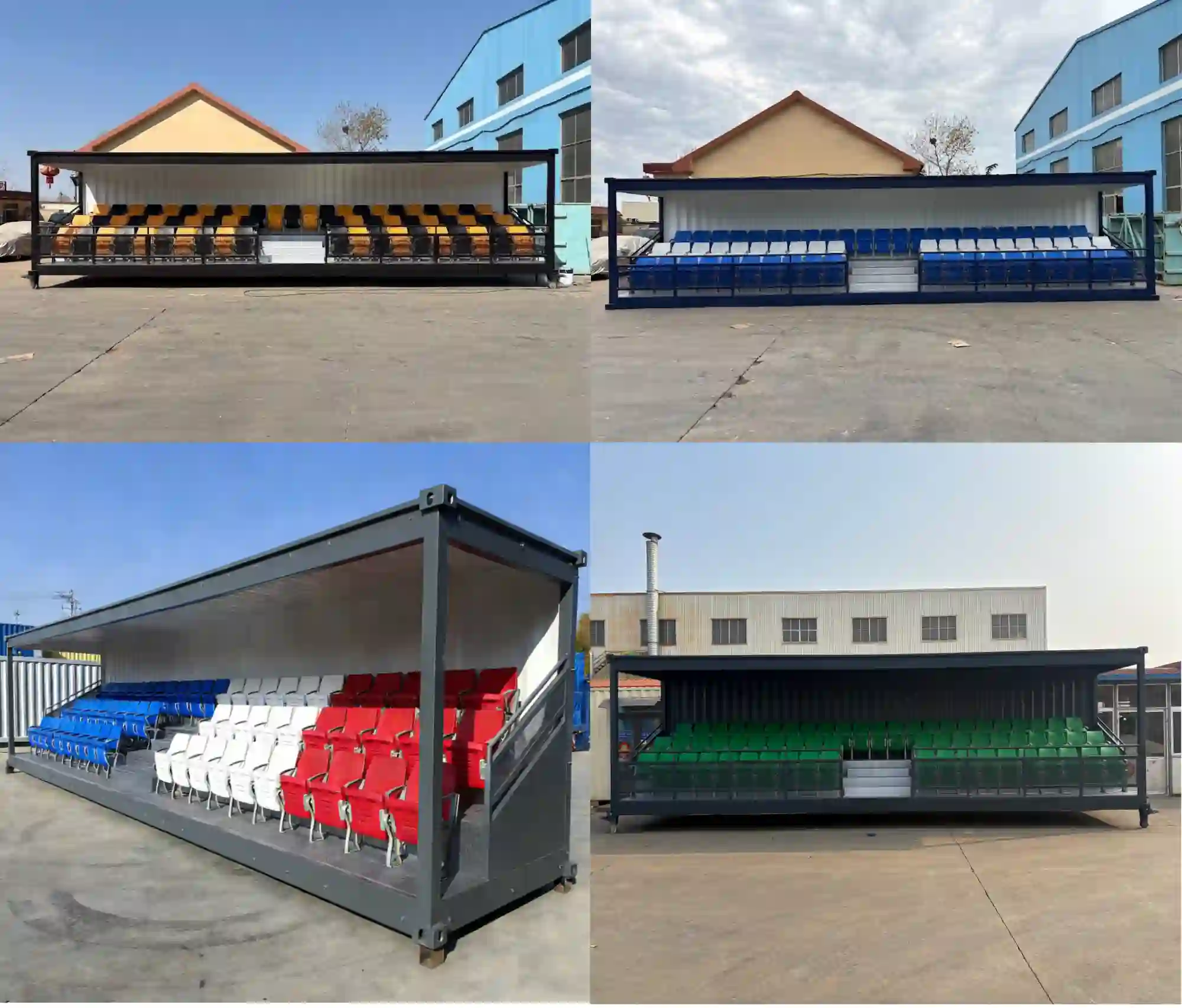
From a budget deadlock to the construction of 2,400 seats within 6 weeks
A regional football organization in Victoria, Australia, has been applying for funds from the government for the permanent expansion of the stands for four consecutive years. The project is estimated to cost 1.2 million Australian dollars, far exceeding the government’s available budget. With the recommendation of the state-level association, the organization signed a purchase contract with a container stand supplier.
This modular stand, which can accommodate 2,400 people, is composed of 38 container modules and is installed on the original concrete foundation. It was put into operation 60 days after the contract was signed. The monthly rental cost has been included in the existing infrastructure budget of the association.
Finally, an Australian modular stand project was successfully completed at a cost of 900,000 Australian dollars, reducing the expenditure by 300,000 Australian dollars compared to before and reducing the construction time by 50% compared to traditional stand construction. When the event is over, the container stands can also be rented out to other sports organizations.
“We have entered into a cooperation with this Chinese container stand. They have a professional sales team and technical team. During the procurement stage, I don’t need to invest much effort. I will purchase the container stand again.”
— Infrastructure purchaser, Regional Sports
The buyer profile for China-manufactured container grandstands exported to Australia is broader than many assume. The common thread is not sector — it is the combination of a defined seating need, a fixed or limited capital budget, and a requirement for speed.
Local Government & Municipal Councils
Regional and rural councils operating under fixed annual capital budgets represent the largest buyer segment. Sports infrastructure grants from Sport Australia, state government programmes, and local budget allocations frequently cover the cost of a China-sourced container grandstand where they would fall short of a permanent build. The shorter procurement and construction timeline also aligns with the financial year cycles that govern council spending approvals.
Regional Sports Federations
Football, rugby, cricket, netball, and athletics federations operating at state or regional level often control their own venues without access to government capital funding. Container grandstands purchased outright from China allow federations to own their spectator infrastructure asset — and critically, to on-hire that asset to other events during non-peak periods, creating a revenue stream that partially offsets the purchase cost.
Private Event & Motorsport Companies
Commercial event operators running motorsport rounds, outdoor festivals, equestrian events, and multi-day concerts require scalable, relocatable grandstand capacity that a permanent structure cannot provide. A fleet of container grandstand modules purchased from a Chinese factory gives event companies a deployable, reusable asset that works across multiple events and multiple sites per year.
Schools & Universities
Educational institutions with active sporting programmes and community-use facilities are a growing buyer segment. Australian Government education infrastructure funding rounds increasingly include sports facility upgrades, and container grandstands fit within typical project budget envelopes where permanent construction would not.
Australia container grandstand demand is being driven by a clear structural gap between rising spectator requirements and limited public or private capital budgets. Traditional concrete construction often exceeds financial capacity and delivery timelines, while still carrying long-term maintenance burdens that many councils and event operators want to avoid.
Container grandstand systems provide a practical alternative — combining modular design, rapid deployment, and flexible financial models such as lease or rent-to-own. From regional sports federations to councils and private event operators, the value lies in the same outcome: faster delivery, controlled cost, and the ability to reuse or redeploy assets across multiple venues and seasons.
Rather than treating budget constraints as a limitation, modular infrastructure turns them into a planning advantage. This is the direction modern sports venue development is moving toward — scalable, compliant, and financially flexible seating solutions built for real operational conditions in Australia.
To explore more real deployments and technical configurations, visit our global container grandstand project portfolio and see how Container House Co., Ltd delivers scalable spectator solutions across different countries and event scenarios.
Seu endereço de e-mail não será publicado. Os campos obrigatórios estão marcados *
 Inglês
![1. O Que É um Projeto de Arquibancada em Contêiner? Um projeto de arquibancada em contêiner refere-se ao planejamento, design, fabricação e instalação de estruturas de assentos para espectadores construídas a partir de contêineres ISO reaproveitados ou construídos para esse fim. Essas unidades modulares são empilhadas, reforçadas e equipadas com assentos de arquibancada, corrimãos de segurança e comodidades para criar arquibancadas temporárias ou semipermanentes para eventos esportivos, concertos, automobilismo, […].](https://gkcpro.com/wp-content/uploads/2026/06/container-grandstand-project-150x150.webp)