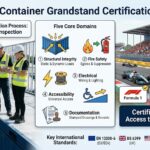
What Is Container Grandstand Certification? Container grandstand certification is an official verification process that confirms a modular, shipping-container-based spectator stand meets all applicable structural, fire, electrical, and crowd-safety requirements before it can be legally occupied by the public. Certification is issued by an accredited third-party inspection body, a national authority, or both — depending on the […]
Container grandstand certification is an official verification process that confirms a modular, shipping-container-based spectator stand meets all applicable structural, fire, electrical, and crowd-safety requirements before it can be legally occupied by the public. Certification is issued by an accredited third-party inspection body, a national authority, or both — depending on the jurisdiction where the structure is deployed. Unlike permanent stadium construction, container grandstands are temporary or semi-permanent structures that can be assembled and disassembled across multiple sites. This portability creates a complex regulatory environment: a unit certified in Germany may require additional local sign-off before it operates in the UAE. Understanding this landscape is the foundation of any global deployment strategy. The certification covers five core domains: (1) structural integrity under static and dynamic crowd loads, (2) fire safety and egress routes, (3) electrical systems and lighting, (4) accessibility compliance, and (5) assembly & installation documentation. All five must be satisfied before a certificate of occupancy is granted. The tragic Roskilde Festival crush in 2000 and the Duisburg Love Parade disaster in 2010 permanently changed how regulators around the world approach crowd safety at temporary venues. Today, operating an uncertified grandstand — even for a single-day event — can result in immediate closure, criminal liability for the event organizer, and seven-figure fines in many jurisdictions. Beyond legal risk, container grandstand certification serves as a commercial differentiator. Tier-1 event promoters, Formula 1 circuits, FIFA-licensed venues, and Olympic organizing committees now mandate certification documents as part of their supplier onboarding RFP. Without it, a rental company simply cannot bid on the most lucrative contracts. The regulatory landscape for container grandstand certification is fragmented across jurisdictions. However, several international standards form the technical backbone that most national bodies reference or directly adopt. For a deeper technical breakdown, the ISO Technical Committee 104 (Freight Containers) publishes the foundational container specifications that structural engineers must reference when calculating load paths through container grandstand modules. The UK’s Health and Safety Executive (HSE) provides one of the most comprehensive publicly available guidance documents — the Purple Guide to Health, Safety and Welfare at Music and Other Events — which dedicates an entire chapter to temporary demountable structures including container grandstands. While every jurisdiction has nuances, the global certification process for a container grandstand follows a consistent arc across seven stages. A qualified structural engineer produces stamped drawings showing load calculations, connection details, and foundation requirements. Container Inspection & ISO Compliance Each container module is inspected for structural integrity, corrosion, and compliance with ISO 668/1161 dimensions and corner casting specs. Fire Safety Assessment A fire engineer maps egress routes, calculates evacuation times, and specifies suppression systems, detection, and signage. Electrical & MEP Sign-Off All electrical installations must meet local wiring regulations. A certified electrician issues an installation certificate. On-Site Assembly Inspection A third-party inspector attends the completed assembly, checking that the build matches approved drawings exactly. Load Testing (if required) Some authorities require a witnessed load test — typically 5 kN/m² for spectator areas — before issuing the final certificate. Certificate of Occupancy Issued The authority having jurisdiction (AHJ) issues the final certificate. This document must be kept on-site throughout the event. A complete container grandstand certification package typically includes the following documentation. Missing any single item is the most common reason for certification delays. Signed and stamped structural drawings, a geotechnical report if ground anchoring is used, a dynamic crowd-load analysis (per Eurocode 1 or local equivalent), and connection details for container stacking and interlocking. The standards table above lists the applicable code for each market. An evacuation strategy report, a fire risk assessment, material datasheets confirming flame-retardancy ratings (typically Class B-s1,d0 in Europe or Class A or B per ASTM E84 in North America), and a site-specific emergency response plan submitted to the local fire authority. Single-line electrical diagrams, an earthing and bonding strategy, lighting lux-level calculations for emergency routes (minimum 3 lux at floor level per EN 1838), and HVAC documentation for enclosed VIP units. A crowd management plan, a maintenance and inspection log showing the service history of each container unit, certificates of conformity for all proprietary components (seats, railings, staircases), and a contractor competency matrix listing all responsible engineers and their credentials. The primary framework is EN 13200-6 (Spectator Facilities — Temporary Demountable Structures). In addition, all member states require a Declaration of Performance (DoP) under the EU Construction Products Regulation (CPR No 305/2011). Notified Bodies (NoBos) — organizations authorized by EU member states — must carry out third-party assessments for certain structural products used in the grandstand. See our certification process guide for timelines. Post-Brexit, the UK applies its own regime. Container grandstands require approval under the Building Regulations 2010 (specifically Part A — Structure, Part B — Fire Safety, Part M — Accessibility) and must comply with the Event Safety Guide (Purple Guide). The local authority building control (LABC) or an approved inspector issues the completion certificate. The HSE temporary structures guidance is the key reference document. Certification is managed at the state and local level. The primary technical standard is NFPA 102 (Grandstands, Folding and Telescopic Seating, Tents, and Membrane Structures) and the International Building Code (IBC). A licensed Professional Engineer (PE) must stamp drawings in the state of use. The Authority Having Jurisdiction (AHJ) — typically the local fire marshal and building department — issues the temporary structure permit. FIFA World Cup Qatar 2022 established a high-water mark for container grandstand standards in the region. The primary references are NFPA 102, local civil defense authority codes, and — for major sporting events — applicable federation technical delivery standards. Saudi Vision 2030 event projects typically require approval from the General Entertainment Authority (GEA). Allow additional time for ministerial approvals. Container grandstands fall under the National Construction Code (NCC), Volume One, Class 9b (assembly buildings). Structural design follows AS/NZS 1170. State-based private certifiers (Building Surveyors) or local councils issue the occupancy permit. WorkSafe NZ publishes specific guidance for temporary grandstands at public events. China requires approval from the local Municipal Housing and Urban-Rural Development Bureau. Japan applies the Building Standards Law (建築基準法) — container structures require a confirmed exemption or special approval. In Singapore, the Building and Construction Authority (BCA) oversees all temporary structural permits. Allow 16–20 weeks for first-time deployments in these markets. Review the certification timeline section for planning purposes. One of the most common questions event organizers ask is: “How long does container grandstand certification take, and what will it cost?” The honest answer is: it depends on the market, the size of the structure, and whether your design package is complete and correct on first submission. These costs cover third-party inspection and certification fees only — not the internal engineering costs of producing the design package. For complex multi-tier container grandstands (3,000+ seats), total engineering and certification costs typically range from 1–3% of the structure’s rental value for the event. After analyzing hundreds of container grandstand certification submissions across global markets, the following factors consistently separate first-time passes from costly re-submissions. The most expensive mistake is treating structural engineering as a box-ticking exercise at the end of the design process. Engage your SE from day one — before containers are purchased — so load paths, connection details, and foundation strategies are baked in, not bolted on. Reference the seven-stage certification process to understand where the SE’s role begins. Several manufacturers now offer container grandstand systems with type approval certificates from TÜV, Bureau Veritas, or Lloyd’s Register. Using a type-approved system reduces third-party inspection scope significantly — the certifier reviews the site-specific installation rather than the base design from scratch. The Bureau Veritas global network is particularly strong for this approach in Europe, the Middle East, and Asia-Pacific. In most markets, a pre-submission meeting with the Authority Having Jurisdiction is available — and strongly recommended. A 60-minute meeting before you submit drawings can prevent a 6-week resubmission cycle. Ask explicitly what their specific local requirements are beyond the national standard. Certifiers need to trust that what they inspect on day one of assembly is what will be there on event day. A robust maintenance and inspection log, combined with documented serial numbers for every structural component, closes this gap. The documents section above outlines the full documentation package required. In markets like the UK and Australia, a container grandstand used at multiple events in the same season may require periodic re-inspections — particularly if the structure is re-erected on different ground conditions. Build a compliance calendar into your event operations plan, and retain the services of a competent person (as defined by the applicable legislation) throughout the event period.What Is Container Grandstand Certification?
Why Container Grandstand Certification Matters for Global Events
Key International Standards & Regulations
Standard / Code
Scope
Key Markets
Status
EN 13200-6
Spectator facilities — temporary demountable structures
EU / EEA
Mandatory
BS 6399-1 / Eurocode 1
Loading codes for structures (incl. crowd loads)
UK, Ireland, EU
Mandatory
ISO 668 / ISO 1161
Series 1 freight containers — specifications
Global
Reference
NFPA 102
Standard for grandstands, folding and telescopic seating, tents
USA, Middle East, Southeast Asia
Mandatory
AS/NZS 1170.1
Structural design actions — permanent, imposed, other
Australia, New Zealand
Mandatory
FIFA / World Athletics TDS
Technical delivery standards for event venues
FIFA / WA event hosts
Conditional
CSA S269.2
Access scaffolding / temporary structures
Canada
Mandatory
Step-by-Step Container Grandstand Certification Process
Required Documents & Inspections
Structural Package
Fire Safety Package
Electrical & Mechanical Package
Operational Documentation
Regional Certification Requirements by Market
🇪🇺 Europe (EU / EEA)
🇬🇧 United Kingdom
🇺🇸 United States
🇦🇪 Middle East (UAE, Saudi Arabia, Qatar)
🇦🇺 Australia & New Zealand
🌏 Asia (China, Japan, Southeast Asia)
Certification Timeline & Costs
Market
Typical Timeline
Approx. Third-Party Cost
Key Variable
UK
6–10 weeks
£4,000 – £15,000
LABC vs. Approved Inspector route
EU (Germany / France)
8–14 weeks
€5,000 – €20,000
NoBo category / capacity
USA
4–8 weeks
$3,500 – $18,000
State & county AHJ
UAE / Qatar
10–16 weeks
AED 20,000 – 80,000
Civil defense & municipality
Australia
6–10 weeks
AUD 6,000 – 25,000
State / Territory building surveyor
China
16–24 weeks
RMB 50,000 – 200,000
Bureau approvals + local fire authority
How to Pass Container Grandstand Certification First Time
1. Engage Your Structural Engineer at the Design Stage
2. Use Pre-Certified Container Modules Where Available
3. Pre-Submit for AHJ Comment
4. Document Every Component with a Paper Trail
5. Plan for Ongoing Compliance, Not Just Initial Certification
Your email address will not be published. Required fields are marked *



 English